Why the Future of Resumes is JSON (Not PDF)
Loading image...
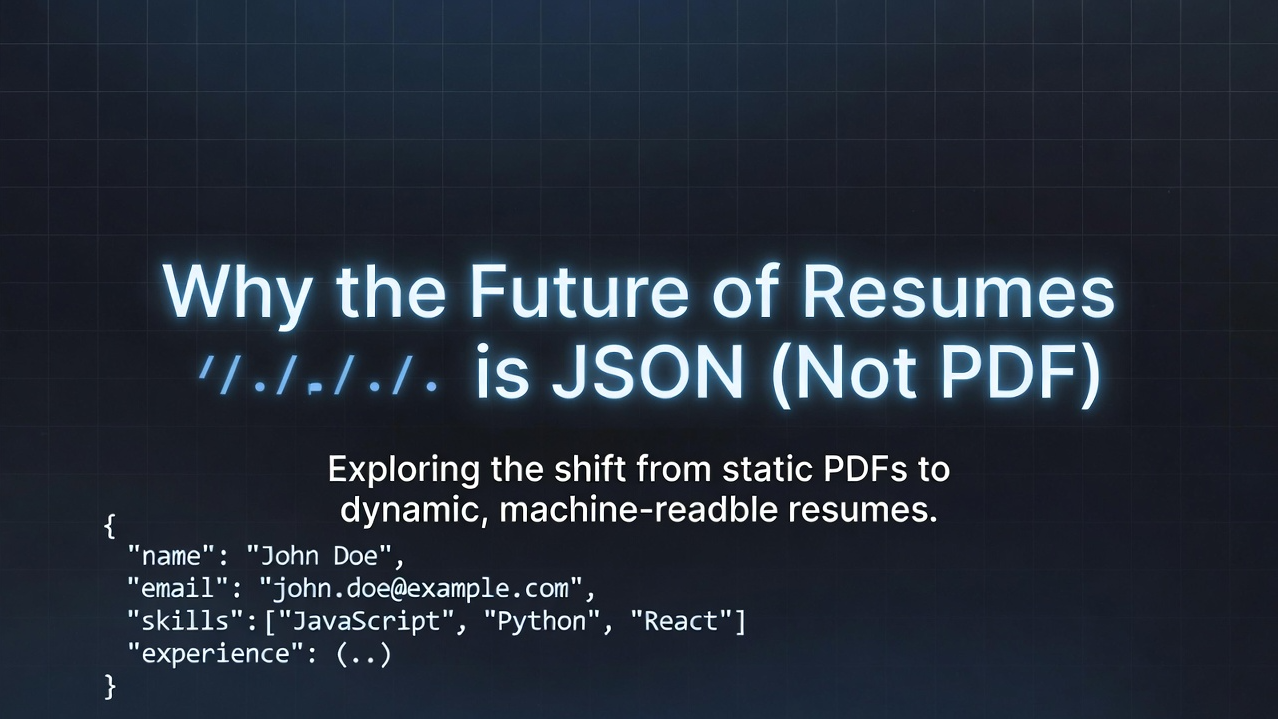
As developers, we hate tight coupling. We would never hard-code our database content directly into our HTML view layer. Yet, that is exactly what a traditional PDF resume is.
A PDF couples your Data (Skills, History) with your Presentation (Fonts, Margins). If you want to change the font, you risk breaking the data.
The "Resume as Code" Philosophy
The future of career data is structured objects, specifically JSON.
Imagine your career history stored as a clean JSON object:
{
  "basics": {
    "name": "Alex Dev",
    "label": "Software Engineer"
  },
  "work": [
    {
      "company": "Tech Corp",
      "position": "Senior Dev",
      "startDate": "2023-01-01"
    }
  ]
}
Why this matters for you
- Portability: You can take that JSON and render it into 50 different templates instantly. No more rewriting bullet points.
- Version Control: You can store your career history in a private GitHub repo.
- API Ready: In the future, you won't upload a PDF; you will POST your JSON endpoint to a recruiter's API.
How Resumemind Handles Data
We built Resumemind on this exact principle. We treat your input as structured data first. We only render it to PDF/DOCX at the very last second using a dedicated engine.
This ensures that no matter which template you choose, your data remains pure, portable, and error-free.
🚀 Treat Your Career Like Code
Stop formatting text boxes. Start managing data. Switch to a builder that understands the difference.
Build Your Data-Driven Resume →
0 Comments
No comments yet. Be the first to comment!